
FOREIGN NEWS
UN Expresses Deep Concern Over Schoolgirls’ Abduction In Nigeria, Calls For Gender Equality, Empowerment


The United Nations (UN) has expressed deep concern over the abduction of schoolgirls in Nigeria.
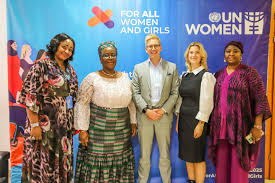
UN Women Deputy Executive Director, Nyaradzayi Gumbonzvanda, who was in Nigeria on an official visit on the weekend, voiced the international body’s apprehension regarding the ongoing kidnappings in schools across the country.
She also called for gender equality, empowerment, and the protection of rights for all women and girls in Nigeria.
Gumbonzvanda stated that, as a mother, she personally feels the pain of what the abducted children are experiencing.
She said: “At the outset, as a mother and as a leader, I want to express my deep pain over the abductions of our daughters that we continue to witness. I felt it was important to express this immediately.
“I therefore join my voice to call for the release of the abducted daughters of this nation. As a mother, my stomach churns when I wonder: What did she eat today? Where did she sleep tonight? Was she inappropriately touched?
“What are her fears and traumas? I also think of her community, their communities, and their families. Therefore, I reaffirm that every girl has, and must have, a right to security and to education.”
She added: “Violence against women and girls remains pervasive in Nigeria, with the abductions I have mentioned and attacks on schoolgirls highlighting the urgent need for safety in schools, in our homes, in our communities, and online.”
She explained that “This is critical because globally, nearly one in three women experience physical or sexual violence in their lifetime.”
Gumbonzvanda also decried the alarming rate of Technology-Facilitated Gender-Based Violence, calling for proper protections for the girl child.
She said: “A critical area of concern remains technology-facilitated gender-based violence, which is rising globally and nationally. Between 16% and 58% of women worldwide experience some form of online or technology-facilitated gender-based violence, depending on the region.
“Globally, one in three women experiences physical or sexual violence. And technology-facilitated abuse affects up to 58% of women, according to our UN Women data from 2022.”
The UN Women official also noted that UN Women is supporting governments and stakeholders in strengthening policy frameworks, enhancing digital safety, and promoting accountability for online harms.
She, however, stressed the importance of a legal framework to address this menace.
According to her, “Effective legal frameworks and inclusive governance are essential to reversing this trend. My discussions with ambassadors accredited to Nigeria also underscored the importance of enhanced regional cooperation, particularly across the Sahel and West Africa, where women’s leadership and peace-building efforts are indispensable for stability and sustainable development.”
Gumbonzvanda commended the Nigerian National Assembly’s strong commitment to strengthening legislation that protects women and girls, and for advancing measures to expand women’s participation in governance.
She also commented on women’s representation in the National Assembly, which stands at 3.8%, far below the global average of 27.2% according to Inter-Parliamentary Union data from 2025.
She urged the country to adopt “legislative reforms such as affirmative action, such as quotas, and the proposed special seats, which are globally recognised to accelerate women’s participation.”
She said: “These measures are not just there to strengthen democracy, but also to ensure the rule of law, so that budgets reflect the needs of half of the population.”
She therefore views the ongoing debate on the special bill as positive, stating: “I am truly excited to be in this country as it engages deeply, boldly, and confidently on the special seats bill.
“I look forward to the day when it will be passed. This is important in every country, and also, as the UN, special measures are part of international standards.
“Equally, we have SDG 5 on women in decision-making, which aims for gender parity by 2030. So, Nigeria’s efforts are a good, progressive approach towards that goal. Economic empowerment is vital for sustainable development.”
On the need to empower women, Gumbonzvanda stressed that women make up over 70% of Nigeria’s agricultural labor force, yet face barriers to land, credit, and markets.
She noted that: “Gender-responsive budgeting and investments in women farmers and entrepreneurs can unlock growth and resilience. Closing gender gaps in labor participation could add up to $12 million to global GDP by 2025, according to data from McKinsey, proving that empowering women is smart economics.
“Empowering women economically is not charity; it is innovation, it is development, it is a benefit that extends to the entire community. Some of us are sitting here today because our mothers in rural areas were empowered to sell their goats at the market and pay school fees, to be able to provide soap and sugar. After all, our mothers were able to generate a little income for the family.
“So, economic empowerment is not just about national economic data; it’s about everyday life in our communities. To sustain and scale progress, predictable and innovative financing is essential.”
Speaking on her visit, which is her first to Nigeria, the UN official said it was to deepen partnerships, reinforce national leadership, and accelerate collective action to advance gender equality, empowerment, and rights for all women and girls in Nigeria.
She noted that the visit has allowed her to witness the tangible impact of UN Women’s work in communities.
Gumbonzvanda said: “Over the past few days, I have engaged with various stakeholders and partners. I’ve engaged with members of the National Assembly, diplomatic partners, the United Nations country team, civil society organisations, and community women who are driving progress at the grassroots level.”
She also narrated her experience in Kwali, a community in the Federal Capital Territory, where she joined women to peel cassava and process it into flour.
She said: “We enjoyed it with Egusi soup. It was a very important experience for us to see how agro-processing can be done in communities, and to understand what it takes and what is needed to provide the transformation required.”
She also revealed that targeted investments to improve women’s lives in agro-processing are very important.
“It was also very clear that investments to improve economic empowerment at the community level would reduce time burdens, expand income-generating opportunities, and unleash the potential of women.”
She explained that: “Globally, access to safe water and sanitation reduces the time women spend on unpaid care work. This is so important that we invest in water and sanitation.
“And when women have greater access to water and sanitation, it enables them to participate more fully in economic activities.
“These are practical examples of how empowering women strengthens communities and enhances resilience, as we translate policy into lived experiences in our communities.
“Within the UN system, I have interacted with our colleagues and reiterated UN Women’s commitment to coordinated, multi-sectoral action, particularly on gender-based violence prevention, women’s economic empowerment, and advancing the women’s peace and security agenda in Nigeria.”
She assured Nigerian women that “UN Women will continue to mobilize partnerships across governments, development partners, and the private sector to ensure that front-line organizations and national institutions have the resources required to deliver lasting change.
“Nigeria has demonstrated strong leadership and a clear commitment to advancing the rights of women and girls. UN Women stands ready to continue supporting these national efforts, working with all partners to translate commitments into measurable, transformative results.”




NDC Sets Guidelines, Modalities For Party Primaries

NDC Primary: Bishop Ossai Secures Candidacy For Enugu North Senatorial Zone

Julius Berger Leads Major Rehabilitation Programme Of Third Mainland Bridge, Others In Lagos

Ama-ano Nsulu Community Presents Eze Udo 11, Chief Chinonyerem Dimgba, To Isiala Ngwa North LGA

Hensard University VC, Prof. Kota, Leads Discussion At Webinar On Innovations In African Higher Education

Otuaro Hails Esther Matthew Tonlagha Foundation Boss On Conferment With Honorary Doctorate Degree

-

 ENTERTAINMENT & CULTURE4 months ago
Ama-ano Nsulu Community Presents Eze Udo 11, Chief Chinonyerem Dimgba, To Isiala Ngwa North LGA
-
EDUCATION4 months ago
Hensard University VC, Prof. Kota, Leads Discussion At Webinar On Innovations In African Higher Education
-
EDUCATION6 months ago
Otuaro Hails Esther Matthew Tonlagha Foundation Boss On Conferment With Honorary Doctorate Degree
-
ENTERTAINMENT & CULTURE5 months ago
AFRIMA Boss Champions Pan-African Cultural Federation At Moroccan Forum
-
OPINION5 months ago
Bandits, States, And The Dynamics Of Illicit Economies
-
FOREIGN NEWS6 months ago
Nigerians In America Demand U.S. Action Against Genocide Perpetrators, Seek Accountability, FBI’s Release Of Tinubu Files
-
OPINION6 months ago
Mr. President, Enough Of The Withdrawals And Replacements
-
CRIME6 months ago
NSCDC Intercepts Human Trafficking Syndicate, Rescues 14 Egypt, Israel Bound Victims
-
ENTERTAINMENT & CULTURE6 months ago
Odo-Nla Royal House Throws Weight Behind K1 De Ultimate For Awujale Throne
-
NATIONAL NEWS6 months ago
Tinubu Hails Nigeria’s Military For Defending Democracy, Thwarting Benin Coup
-
OPINION5 months ago
Between Imperialism And Military Rule: The Choiceless Political Reality In West Africa
-
OPINION6 months ago
How Pro-Russian, Coup-Supporting ‘Activists’ Were Exposed, Discredited


Destiny86
08/12/2025 at 4:14 am
https://shorturl.fm/QRH2z